
Prof. Dr. Leo Brecht


Member of the Board, Partner


Prof. Dr. Leo Brecht
Member of the Board, Partner
Prof. Dr. Leo Brecht is a mathematician and economist with a PhD in mathematical statistics and a professorship in innovation and technology management at the University of Liechtenstein. With over 20 years of experience in management consulting and applied research, and more than 10 years in investment management, he is a leading expert in the fields of innovation, technology and product management. Leo Brecht has supported more than 100 projects for SMEs and multinational companies in various industries, from strategic consulting to technology assessments. He is also the founder of ALPORA, where he and his team have developed innovative investment products that have led to over €700 million in assets under management. Over the last ten years, he has given more than 1,000 investor presentations. He was a partner at Andersen and Arthur D. Little, the author of several books and a conference speaker. As an active investor and serial entrepreneur, he is particularly involved in the FINTECH, SUSTTECH and EDUTECH sectors. In his free time, Leo Brecht is a passionate regatta sailor and skier and enjoys spending time with his family.
Artificial intelligence is often discussed as a general-purpose technology whose economic impact will emerge gradually across the enterprise. Manufacturing offers a more concrete test. A factory already records the signals an AI system needs: units produced, defects detected, machine cycles, energy use, downtime, and scheduling decisions. The work is repetitive, high-volume, and connected directly to operational cost.
That combination makes production operations an unusually measurable setting for AI. The strongest use cases do not begin with an abstract promise to “transform the factory.” They begin with a narrow loop: inspect every unit, detect a deviation earlier, re-sequence production, or adjust a process before a small issue becomes a costly failure.
The investment question is therefore not simply which company has the most advanced model. It is technology that can close the loop between data, decision, and physical action—and repeat that improvement across lines, plants, and customers.
From sampled control to continuous adjustment
Traditional production management is often built around periodic review. A line produces, a sample is inspected, an operator investigates a signal, and a planner updates the schedule. This process can be effective, but it is inherently delayed and selective. It may identify a quality problem only after an entire batch has moved through the line, or re-plan only at the next formal scheduling cycle.
AI changes the cadence. Computer vision can inspect each unit at line speed. Equipment analytics can monitor vibration, temperature, cycle time, and energy draw continuously. Scheduling systems can react to machine downtime, material delays, and order changes as they occur. The result is not necessarily a fully autonomous factory. It is a faster operating loop in which difficulties are detected and corrected closer to their point of origin.
Diagram comparing a traditional production loop with an AI-accelerated continuous loop.
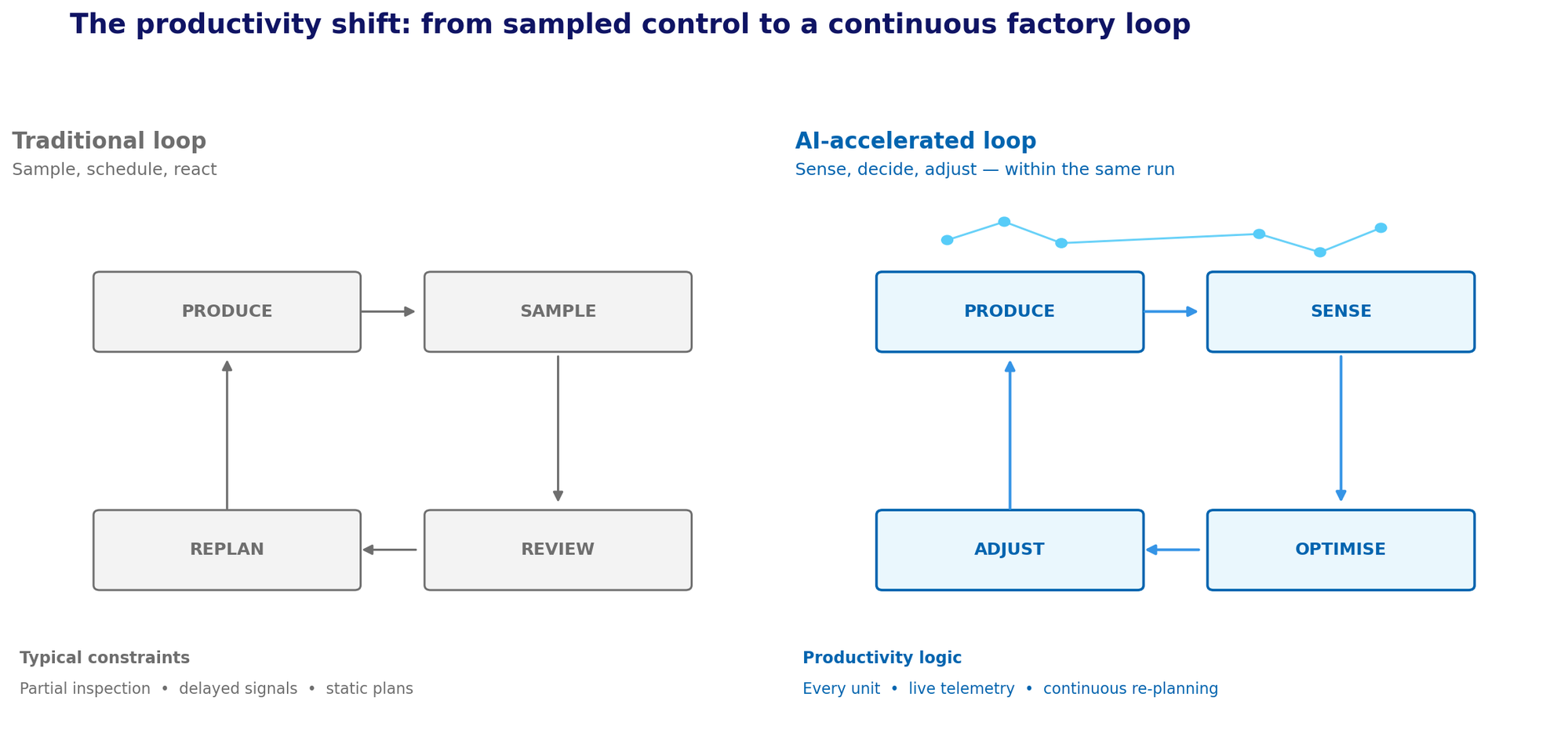
This distinction is relevant for investors. A productivity gain created by a one-off capital project may be difficult to replicate. A software-enabled feedback loop, by contrast, can become more valuable as it is deployed across additional production lines—provided the system can integrate with existing equipment and the customer can operationalize its recommendations.
Why is manufacturing a particularly favorable AI domain
Manufacturinghas two structural advantages compared with less instrumented corporatefunctions.
First, the output is already measured. Production systems routinely capture counts, cycle times, defect codes, machine states, and energy consumption. An AI application can therefore learn from an existing operational data trail rather than waiting for a new measurement system to be built from scratch.
Second, small improvements compound quickly. A modest reduction in false alarms, scrap, or changeover time can matter materially when it is repeated across thousands of units and multiple shifts. In a high-volume environment, a small improvement per unit can become a meaningful annual effect.
Quality inspection and production scheduling are especially suitable. Human inspections are difficult to maintain at the same level of attention throughout a full shift. Static schedules are also poorly suited to a production environment where late materials, machine stoppages, and product-mix changes are normal rather than exceptional.
The implication is not that people disappear from the process. Often, the most practical deployment is an AI system that prioritizes exceptions, removes repetitive checks, and provides operators better information. The human role shifts from reviewing every ambiguous signal to resolving the cases where context and judgment matter most.
Three technology layers—and why they should not beconflated
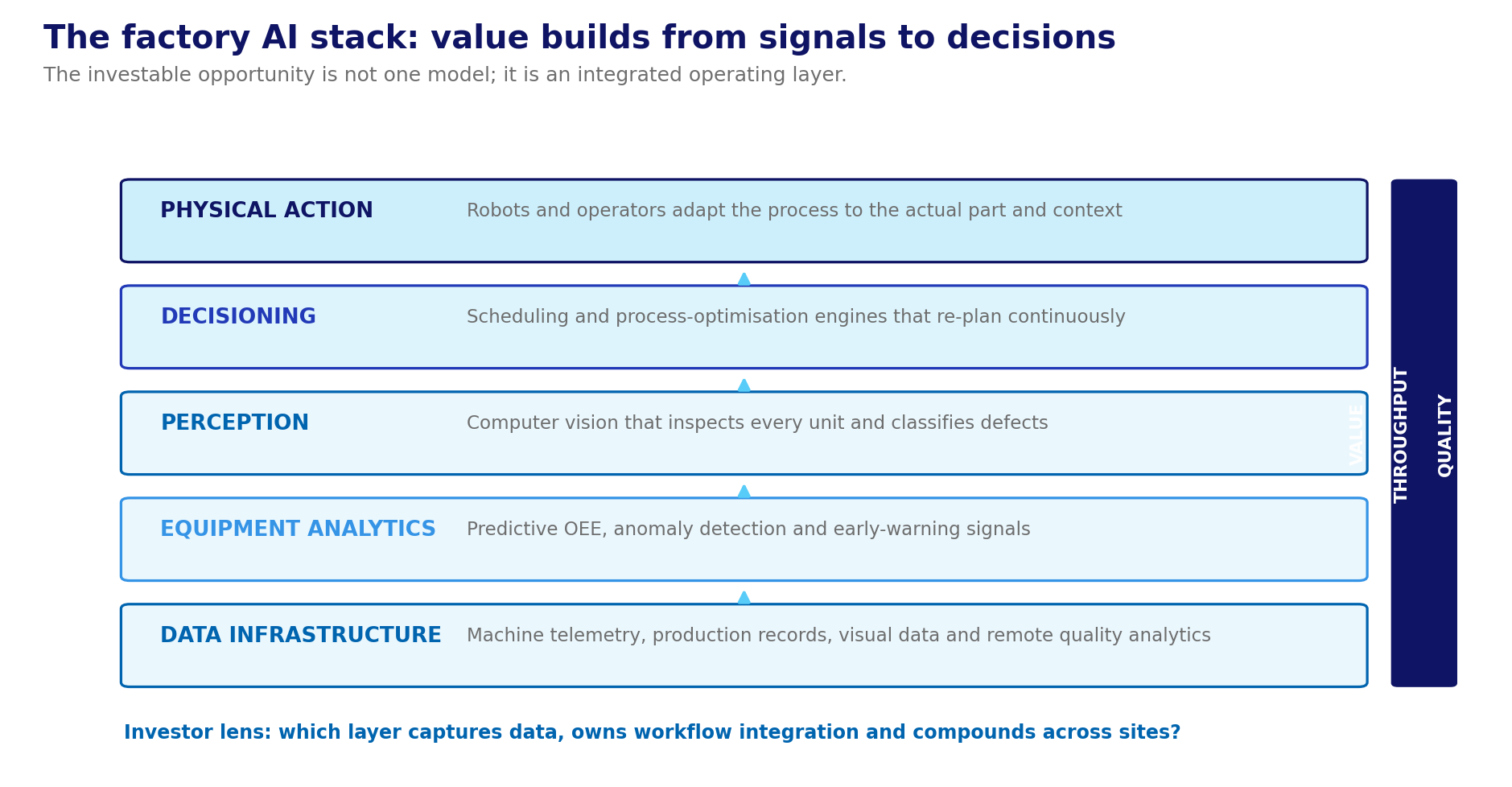
The supplied manufacturing deep dive maps the domain across several technique families. They solve different problems and carry different commercial and competitive characteristics.
1. Perception: seeing every unit
Computer vision systems analyze images of products or components and classify defects such as scratches, missing parts, weld irregularities, or color mismatches. The productivity opportunity is straightforward: inspect the full output continuously rather than checking a sample or relying on fatigued manual review.
The practical challenge is data. Rare defects are, by definition, difficult to represent in large training sets. Platforms that can learn from relatively small labeled datasets, work in high-mix environments, and integrate with existing inspection equipment may therefore have a more useful proposition than a technically impressive model that requires extensive bespoke preparation.
2. Decisioning: re-planning the line
Production scheduling is a constrained optimization problem. Orders, materials, machines, labor, changeovers, and delivery dates interact continuously. AI-enabled scheduling systems aim to re-solve the plan as conditions change rather than treating the schedule as fixed until the next planning cycle.
The economic value comes from protecting throughput and reducing avoidable idle time. But the quality of the implementation matters: a schedule that is mathematically efficient yet difficult for planners and operators to understand may not be adopted. Explainability and workflow integration are therefore commercial features, not merely technical preferences.
3. Equipment analytics and physical action
Predictive analytics searches for patterns in telemetry that precede downtime, quality loss, or yield deterioration. Robotics adds the physical layer: a machine can sense variation in the part in front of it and adapt its movement instead of repeating a fixed program.
These categories differ in capital intensity. A cloud-based analytics application can often be deployed with limited hardware changes. A robotics solution must combine software, sensors, mechanical systems, testing, and on-site service. For capital allocators, the distinction affects funding requirements, sales cycles, implementation risk, and the potential durability of competitive advantage.
The evidence is moving from pilot to plant economics
The most useful evidence comes from named production sites with defined operational metrics. Three European examples in the supplied deep dive illustrate different routes to value.
At Siemens' Rastatt facility in Germany, AI-driven false-call reduction software was layered on top of automated optical inspection equipment used on printed circuit board assemblies. The reported result was a 42% improvement in initial first-pass yield, without replacing the inspection machines. The case illustrates an important principle: AI value can come from making existing infrastructure more useful, not only from purchasing new hardware.
At Agilent's Waldbronn facility, a computer-vision toolkit was deployed across five inspection use cases. The supplied brief reports a 49% reduction in defect rates within four months, alongside broader improvements recorded in the site's wider digital transformation. The World Economic Forum’s Global Lighthouse material separately describes the use of AI-assisted inspection, data analytics, and industrial IoT at the plant, as well as reported gains in productivity and output.
At Danone's Opole plant in Poland, connected shop-floor systems, AI-enabled scheduling, and automation formed part of a broader workforce-led transformation. Danone reports a 19% reduction in manufacturing costs between 2019 and 2021, a 12% efficiency gain, and a reduction in greenhouse gas emissions of approximately 50%. The site became a template for deploying the approach across other plants in the company’s European network.

The common thread is not a single vendor or model. It is the combination of a clearly defined operational problem, an existing data stream, and a metric that management already cares about: yield, defect rate, unit cost, efficiency, ,output, or emissions.
The investor lens: Where can value compound?
A useful way to assess the market is to ask four questions.
Does the technology improve a measurable operating metric? A credible use case should connect to yield, throughput, downtime, quality, labor productivity, energy intensity, or another economically relevant measure.
Can it work with the installed base? Solutions that improve existing cameras, machines, or enterprise systems may face less adoption friction than those requiring a complete infrastructure replacement.
Does the product become embedded in a workflow? Data access alone may be replaceable. A system that becomes part of inspection, scheduling, maintenance, or production control can create deeper operational dependence—although it also carries higher integration requirements.
Can the playbook scale across sites? The strongest economics may emerge when a validated use case travels from one plant to a broader network. Replication is not automatic: product mix, equipment age, labor practices, and data quality vary by site. Still, a repeatable implementation method can turn a successful pilot into a platform for wider productivity gains.
This is why the market map matters. Vision inspection, process optimization, predictive equipment analytics, robotics, and manufacturing data infrastructure each represent different combinations of recurring software revenue, hardware exposure, implementation work, and customer switching costs. They should not be analyzed as if they were interchangeable “AI companies.”
What could slow adoption?
The opportunity is substantial, but the path is not frictionless. Data may be fragmented across machines and plants. A model can perform well in one environment and degrade when lighting, materials, or product specifications change. Operators may distrust recommendations that cannot be explained. Cybersecurity and data ownership can become material barriers, particularly where production systems are connected across sites.
There is also a measurement risk. A reported percentage improvement may describe a specific baseline, a particular time window, or one part of a wider transformation. It should not be generalized into a universal expected return. Investors need to distinguish between a customer case study, a controlled pilot, a realized financial benefit, and a scalable commercial model.
Conclusion: The factory is a test of execution, not justinvention
Manufacturing may be one of the clearest places to observe whether AI creates durable productivity. The data is close to the process, the feedback cycles are frequent, and the economic consequences can be measured in units, hours, defects, energy, and cost.
That does not make every industrial AI proposition investable. It does make the domain unusually useful for separating broad technology narratives from operational evidence. The winners are likely to be determined less by the novelty of an algorithm than by the ability to integrate into real factories, earn the trust of operators, improve a metric that matters, and replicate the result across a network.
For investors studying productivity leaders, the relevant question is therefore simple: which companies are turning factory data into a faster, more reliable, and more adaptable operating loop?
