
Prof. Dr. Leo Brecht


Member of the Board, Partner


Prof. Dr. Leo Brecht
Member of the Board, Partner
Prof. Dr. Leo Brecht is a mathematician and economist with a PhD in mathematical statistics and a professorship in innovation and technology management at the University of Liechtenstein. With over 20 years of experience in management consulting and applied research, and more than 10 years in investment management, he is a leading expert in the fields of innovation, technology and product management. Leo Brecht has supported more than 100 projects for SMEs and multinational companies in various industries, from strategic consulting to technology assessments. He is also the founder of ALPORA, where he and his team have developed innovative investment products that have led to over €700 million in assets under management. Over the last ten years, he has given more than 1,000 investor presentations. He was a partner at Andersen and Arthur D. Little, the author of several books and a conference speaker. As an active investor and serial entrepreneur, he is particularly involved in the FINTECH, SUSTTECH and EDUTECH sectors. In his free time, Leo Brecht is a passionate regatta sailor and skier and enjoys spending time with his family.
This article is part of Averdas' twelve-part series on where corporates can achieve productivity gains. Each installment examines one operational domain where AI-driven tools are changing the economics of work. This installment looks at IT, software development, and enterprise systems.
Most productivity claims in corporate IT rest on proxies: self-reported time savings, satisfaction surveys, or anecdotal management impressions. Software development is different. A developer's output—lines of code written, tests passed, tickets resolved, pull requests merged—can be counted and timestamped. That objectivity is why this domain produces some of the most rigorous evidence available anywhere in the broader productivity debate, and why it is worth examining closely before looking at where investment capital is actually flowing.
A domain built for measurement
McKinsey's 2025 survey on AI adoption found that IT, alongside manufacturing, is where organizations most consistently report a realized cost benefit from AI tools—not just an expectation of future benefit. Software development sits at the center of that finding, for a structural reason: because its output is directly measurable, researchers can test productivity claims under controlled conditions rather than relying on inferred proxies. A developer who completes a task faster also typically generates more pull requests for review and resolves more tickets per sprint, so gains in one stage of the development lifecycle tend to show up in the next. This is precisely why the field data on AI coding assistance—discussed below—is treated with unusual confidence relative to other domains in this series.
The toolkit behind the numbers
Public attention tends to focus on AI coding assistants because they sit directly inside a developer's daily editor. But the measured productivity gain in this domain comes from a broader toolkit spanning five technique families:
- AI coding assistants and agents generate, complete, and refactor code inline, ranging from autocomplete-style suggestions to more autonomous agents that can plan, write, test, and ship a change with limited human supervision.
- Autonomous test generation writes and validates unit tests without human review—closing a quality-assurance gap that has traditionally consumed a disproportionate share of engineering time and that is often the first task cut under deadline pressure.
- Agentic IT operations triage support tickets, apply routine patches, and manage infrastructure tasks, escalating only genuine exceptions to a human engineer.
- ERP process automation applies similar techniques to structured back-office workflows such as invoicing and reconciliation—less visible, but running continuously across high-volume administrative processes.
Understanding which category a given vendor operates in matters for anyone assessing whether its technology position is genuinely defensible, since the five families differ sharply in how much independent venture activity they support (more on that below).
What the evidence actually shows
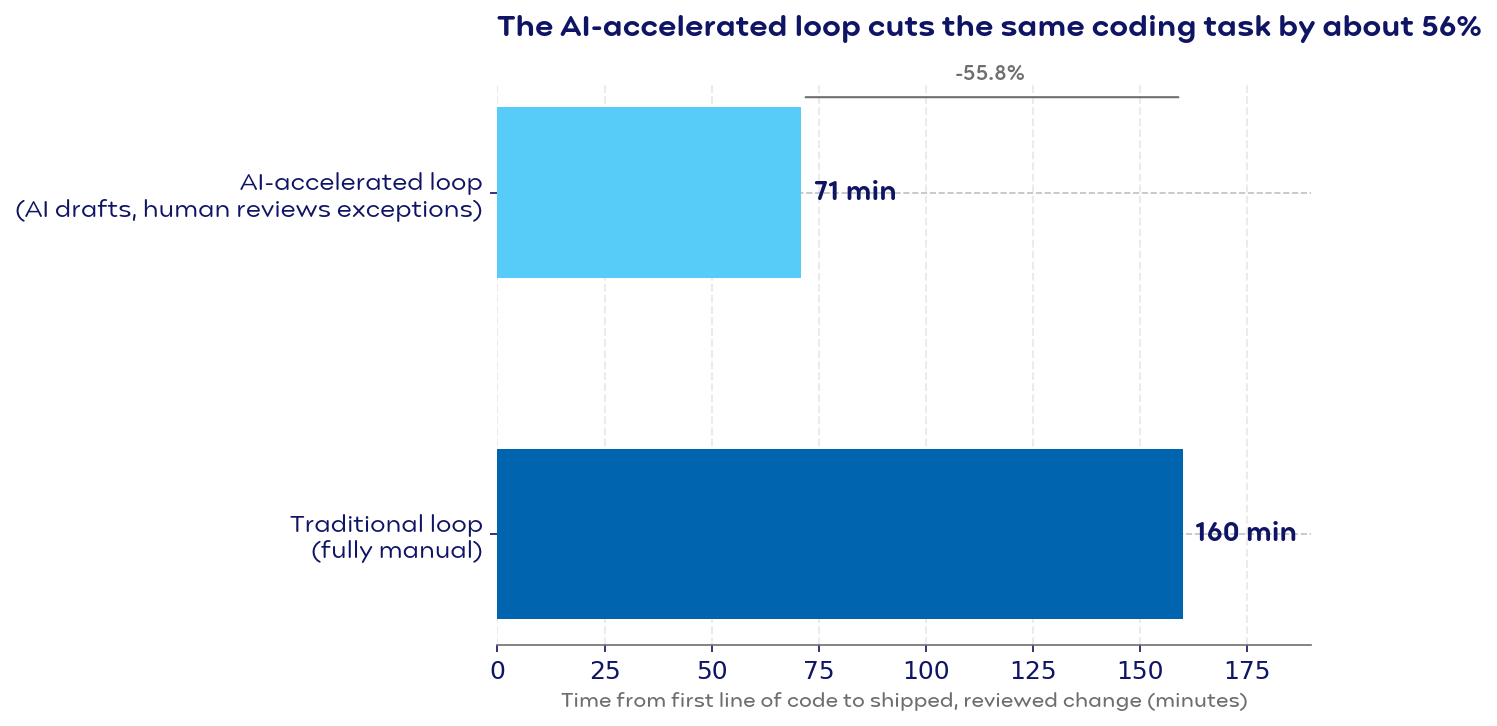
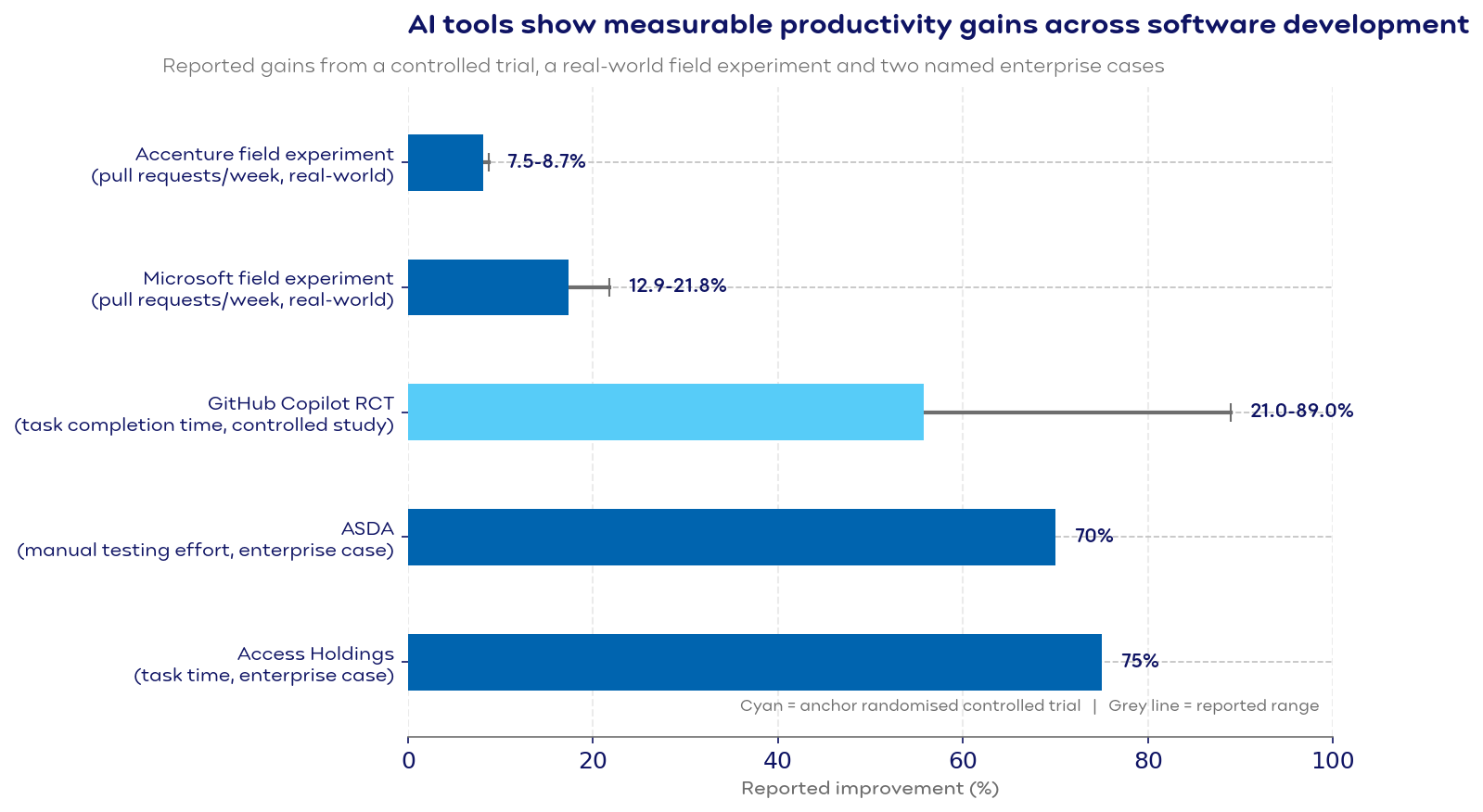
The clearest data point comes from a 2023 randomized controlled trial: 95 professional developers were randomly assigned either to a treatment group with access to GitHub Copilot or to an unassisted control group, and both attempted an identical task—implementing an HTTP server in JavaScript. The treatment group completed the task 55.8 percent faster, with a 95 percent confidence interval spanning 21 to 89 percent, and no statistically significant difference in completion quality.
A separate field experiment tracking real production work at Microsoft and Accenture found a more modest, but arguably more meaningful, result: developers with Copilot access completed 12.9 to 21.8 percent more pull requests per week at Microsoft, and 7.5 to 8.7 percent more at Accenture. The gap between the lab result and the field result matters. The randomized trial shows what is possible under controlled conditions; the field data shows the effect persisting under real code-review processes and real production deployment risk, which is a stronger basis for an investment or adoption thesis than a single controlled task.
Three corporate cases
Two further examples illustrate the toolkit beyond coding assistants themselves. ASDA, the UK retailer, used Perfecto's AI-powered testing platform to scale its mobile application test coverage by 50 percent while cutting manual testing effort by 70 percent—a case for autonomous test generation, a part of the toolkit that receives less public attention than coding assistants but addresses a task that is frequently rushed under release pressure. Access Holdings, a pan-African financial services group, deployed Microsoft 365 Copilot across its development function and reported cutting individual development tasks from eight hours to two, a 75 percent reduction. That case is a useful reminder that these gains are not confined to Silicon Valley technology firms or English-language-dominant markets; they are being realized by financial institutions applying the same underlying tools to their own internal workflows.
Where the capital is going
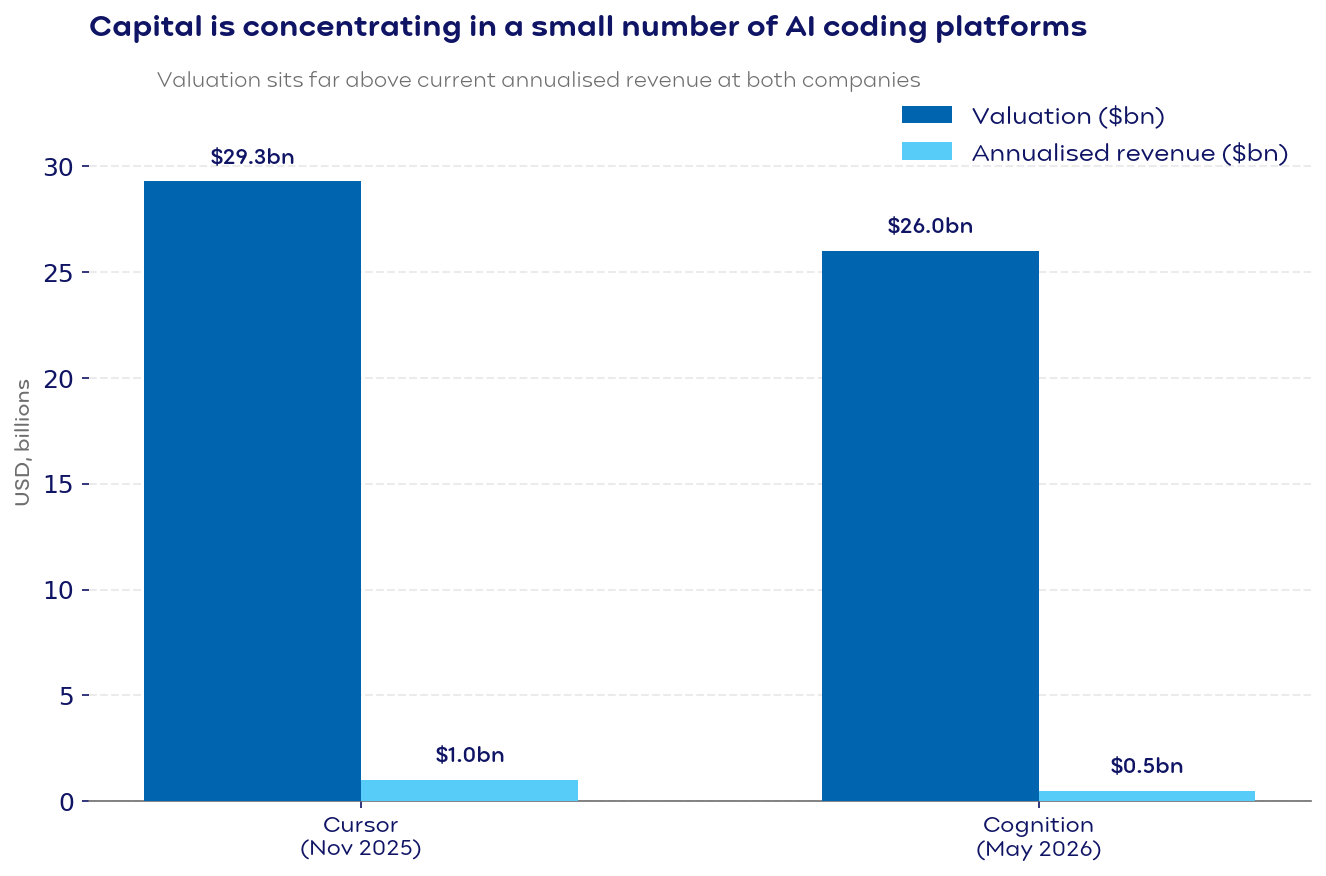
AI coding assistants and agents have become, by some margin, the most capital-intensive category across this entire series. Cursor reached a $29.3 billion valuation in its November 2025 funding round, against roughly $1 billion in annualized recurring revenue—a trajectory that reportedly took the company from $100 million to over $1 billion in ARR in about eleven months. Cognition, maker of the autonomous AI engineer Devin, moved on a similarly steep curve: after acquiring rival AI-native IDE Windsurf in mid-2025 once a competing acquisition offer from OpenAI reportedly collapsed, Cognition's combined revenue is reported to have grown more than thirteen-fold over twelve months, taking its valuation to $26 billion by May 2026.
That degree of capital concentration in a handful of considerable platforms is a distinctive pattern within this series—most other domains show venture funding spread more evenly across several credible independents. By contrast, two of the five technique families here—agentic IT operations and ERP process automation—show comparatively little independent venture activity, largely because those capabilities are being absorbed directly into existing enterprise platforms such as ServiceNow, SAP, and the Microsoft stack rather than sustaining stand-alone companies.
What this means for investors
For allocators, software development is a useful calibration point for the rest of this productivity series, precisely because the underlying claims are unusually well evidenced. At the same time, the venture landscape here is already showing signs of winner-take-most dynamics, with valuation and revenue growth concentrating in some platforms rather than a broad field of comparably sized challengers. Whether that concentration is durable—or whether it compresses as large incumbents build equivalent capability into their platforms—is one of the more consequential open questions for this domain, and one Averdas will continue to monitor as part of its broader productivity research.
This article is part of a twelve-part Averdas series mapping where corporates can achieve measurable productivity gains. Read the full overview at averdas.com/blog/where-corporates-can-achieve-productivity-gains.
