
Prof. Dr. Leo Brecht


Member of the Board, Partner


Prof. Dr. Leo Brecht
Member of the Board, Partner
Prof. Dr. Leo Brecht is a mathematician and economist with a PhD in mathematical statistics and a professorship in innovation and technology management at the University of Liechtenstein. With over 20 years of experience in management consulting and applied research, and more than 10 years in investment management, he is a leading expert in the fields of innovation, technology and product management. Leo Brecht has supported more than 100 projects for SMEs and multinational companies in various industries, from strategic consulting to technology assessments. He is also the founder of ALPORA, where he and his team have developed innovative investment products that have led to over €700 million in assets under management. Over the last ten years, he has given more than 1,000 investor presentations. He was a partner at Andersen and Arthur D. Little, the author of several books and a conference speaker. As an active investor and serial entrepreneur, he is particularly involved in the FINTECH, SUSTTECH and EDUTECH sectors. In his free time, Leo Brecht is a passionate regatta sailor and skier and enjoys spending time with his family.
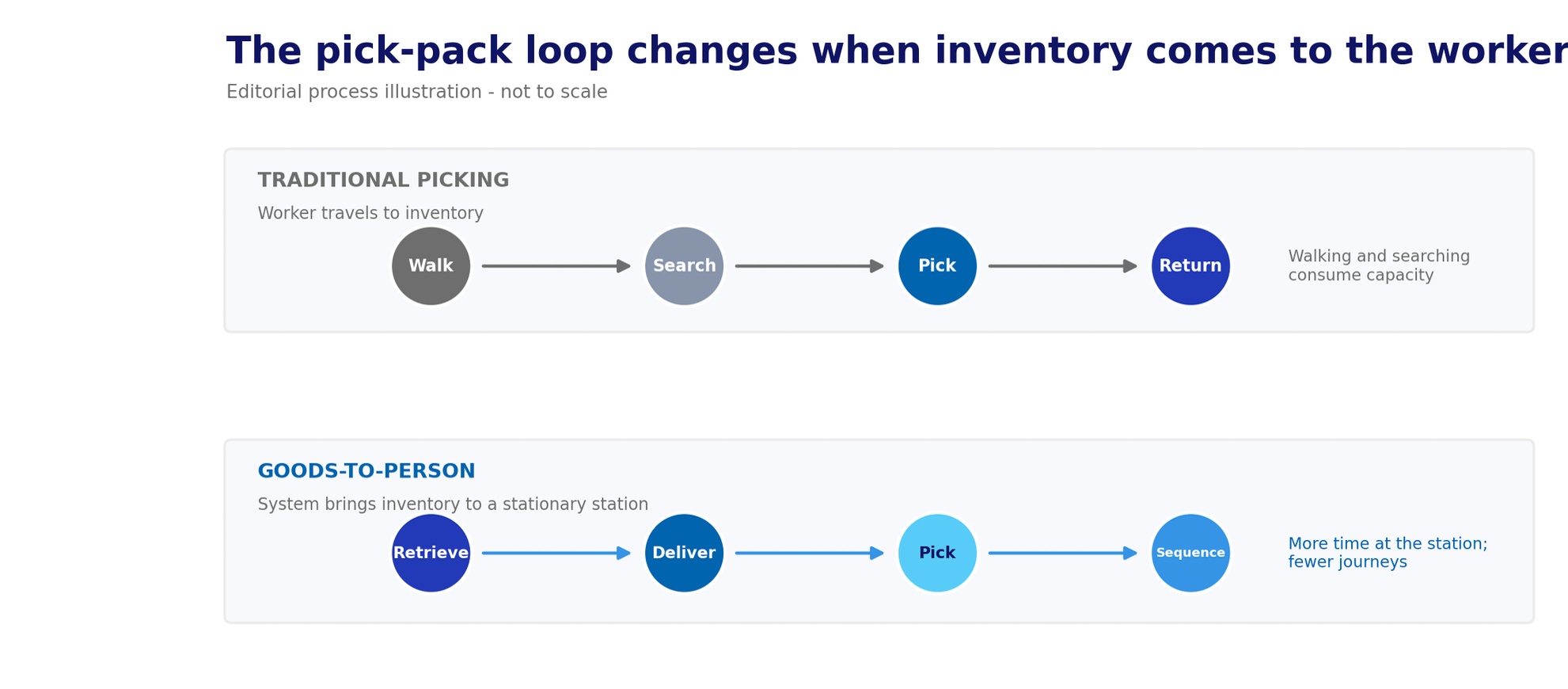
In a distribution center, the most important productivity gain may begin with a deceptively simple change: stop sending people to the inventory and bring the inventory to them. Picking is often the largest single operating-cost item in a warehouse. The reason is not primarily the physical act of removing an item from a shelf. It is the time spent walking to the right location, searching for the correct stock-keeping unit, and returning to the next task. As warehouses become larger and product ranges broader, this movement becomes a structural source of inefficiency.
Goods-to-person robotics reverses that logic. Instead of asking a worker to navigate the warehouse, automated systems bring storage pods, bins, or totes to a stationary picking or packing station. The result is a direct intervention in the largest component of the manual pick-and-pack loop.
This article is part of Averdas’ “Where Corporates Can Achieve Productivity Gains” series, which examines twelve different corporate domains in which technology, processes, and resource allocation can change the economics of production and operations. The series is available at Where Corporates Can Achieve Productivity Gains.
Why picking is a structural productivity lever
A conventional picker spends a significant part of the working day moving through the facility and locating items. That time does not directly increase the number of orders completed. It scales with the size of the building, the number of stock-keeping units, and the complexity of the order profile.
Automation targets this constraint rather than optimizing around it. Autonomous mobile robots can transport shelving pods or totes to a stationary worker. Automated storage and retrieval systems can store inventory more densely and retrieve it on demand. Software can then sequence the work of robots and people so that one process does not become the bottleneck for another.
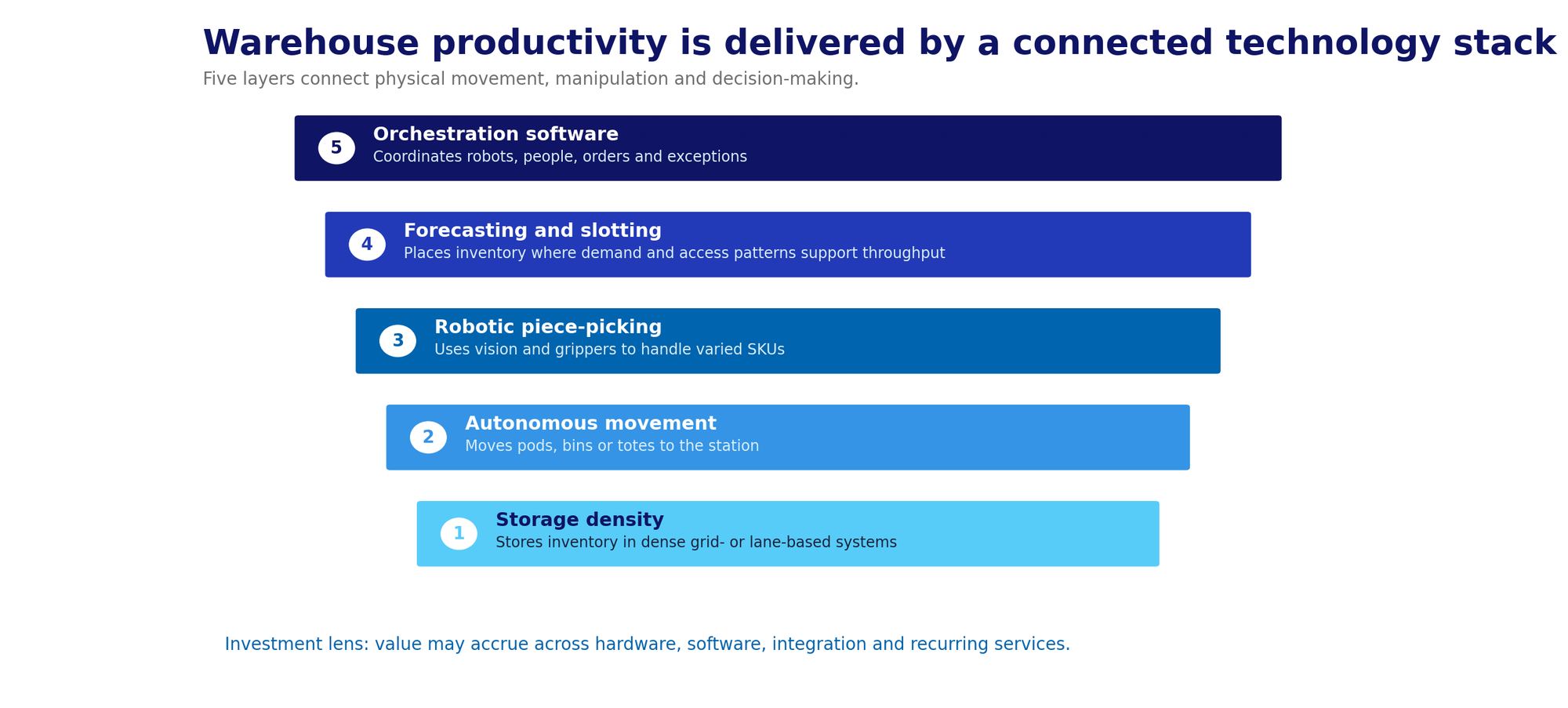
The important point is that warehouse productivity does not depend on a single machine. It comes from the interaction between storage density, movement, manipulation, and orchestration. Improvements at several layers can compound over time.
The technology stack behind the gain
Bringing inventory to the person
Autonomous mobile robots navigate the warehouse floor and move storage pods, bins, or totes to a human picking station. This goods-to-person model reduces walking and search time while retaining human judgment where it remains useful.
The economic logic is straightforward: if the worker remains in one place, more of the shift can be spent scanning, picking, and placing items. The exact improvement depends on the facility layout, order profile, SKU mix, operating schedule, and level of automation.
Teaching robots to grasp
Robotic piece-picking addresses a more difficult problem. A robotic arm must identify and grasp products with different shapes, surfaces, weights, and packaging characteristics. A bag of snacks, a bottle, and a folded garment require different movements and different levels of force.
Computer vision and machine learning systems are improving the ability of robots to handle unfamiliar items. Yet fully autonomous, high-reliability picking across the full range of warehouse products remains an industry-wide challenge. This is one reason why robotic manipulation has attracted both venture funding and technology-led consolidation.
Storing more in the same footprint
Automated storage and retrieval systems use dense grid- or lane-based architectures to store inventory in a smaller physical footprint than open shelving. Fleets of small robots retrieve bins and deliver them to pick or pack stations.
Higher storage density can be particularly relevant where land, labor, or building capacity is constrained. It can also change the design of a facility: automation is not only added to an existing warehouse but can also influence the building’s layout and operating model from the outset.
Deciding where inventory should go
Demand forecasting and slotting systems determine where products should be placed. Fast-moving items can be positioned to reduce the time required for frequent orders, while expected demand patterns can guide replenishment and capacity planning.
This capability is increasingly integrated into warehouse management and enterprise resource planning platforms. For investors, that matters because some productivity capabilities may be captured by established software providers rather than by independent start-ups.
Orchestrating robots and people
The orchestration layer coordinates the movement of robots, inventory, and human workers. It decides which robot should perform which task, which order should be prioritized, and how work should be sequenced at the station.
This is more than a routing system. In a highly automated facility, the software acts as a continuously updated operational model of the building. It must coordinate several workstreams while managing exceptions, replenishment, congestion, and changing demand.
What reported deployments illustrate
Reported operator disclosures show how different layers of the stack can combine. The examples below are not directly comparable productivity studies: they refer to different operating models and measure different outcomes.
Amazon has built warehouse robotics into a large fulfilment network, combining autonomous mobile robots with software-led slotting, sequencing and packing processes. Its development path illustrates an important pattern: new hardware is paired with improvements in orchestration rather than deployed as an isolated technology.
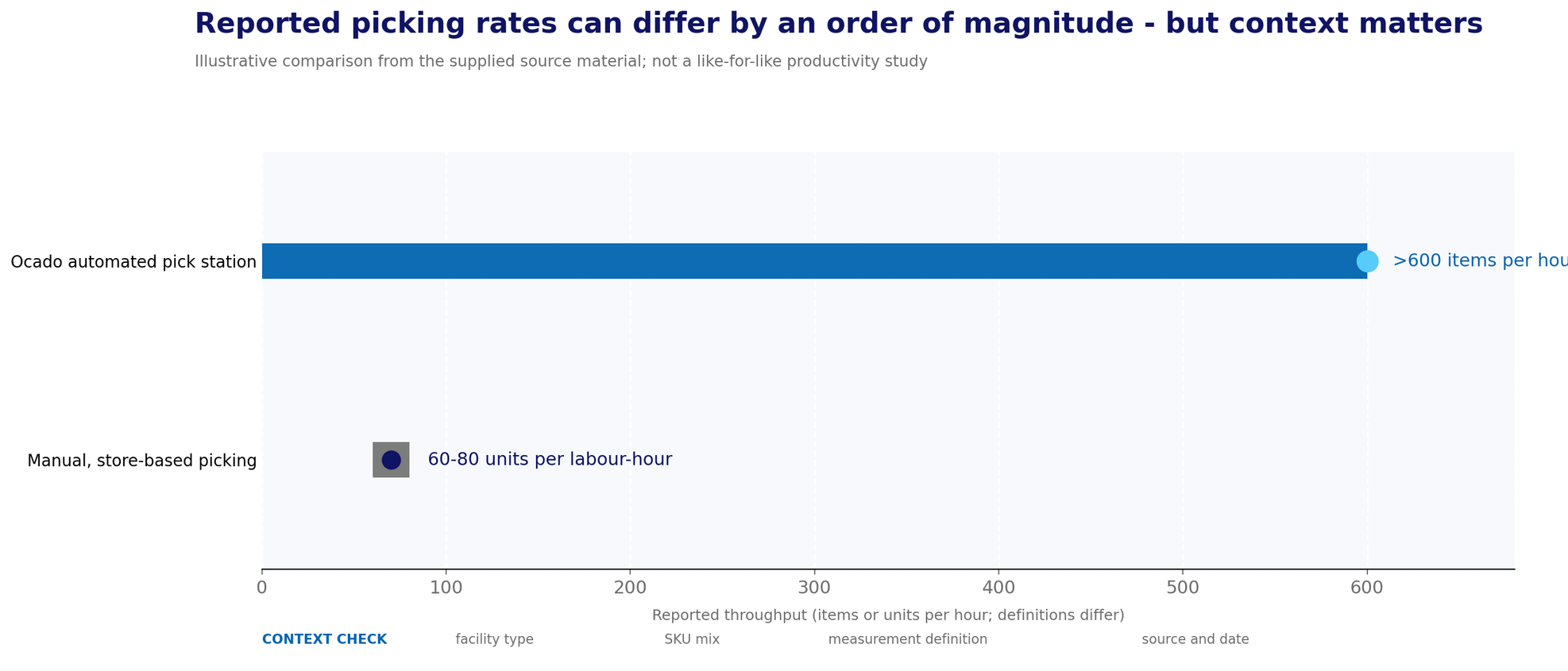
Ocado uses grid-based customer fulfillment centers in which fleets of robots move storage bins to picking stations. The company has reported that adding robotic picking to its existing automated platform can reduce manual labor in picking by a further 50 percent. It has also reported automated pick-station rates above 600 items per hour and accuracy above 99.9 percent. These figures are company-reported and should be read in the context of the specific operating model, product mix, and measurement definition.
Walmart and Symbotic provide an example of automation at a regional distribution center scale. Symbotic’s AI-orchestrated storage-and-retrieval platform is being deployed across Walmart’s regional distribution center network. Symbotic has also reported a contracted backlog of $22.7 billion and strong year-on-year gross profit growth in its most recent reported quarter referenced in the source material. The relationship creates scale, but it also highlights customer-concentration risk: the source material states that more than 80 percent of Symbotic’s revenue still came from Walmart at the time of reference.
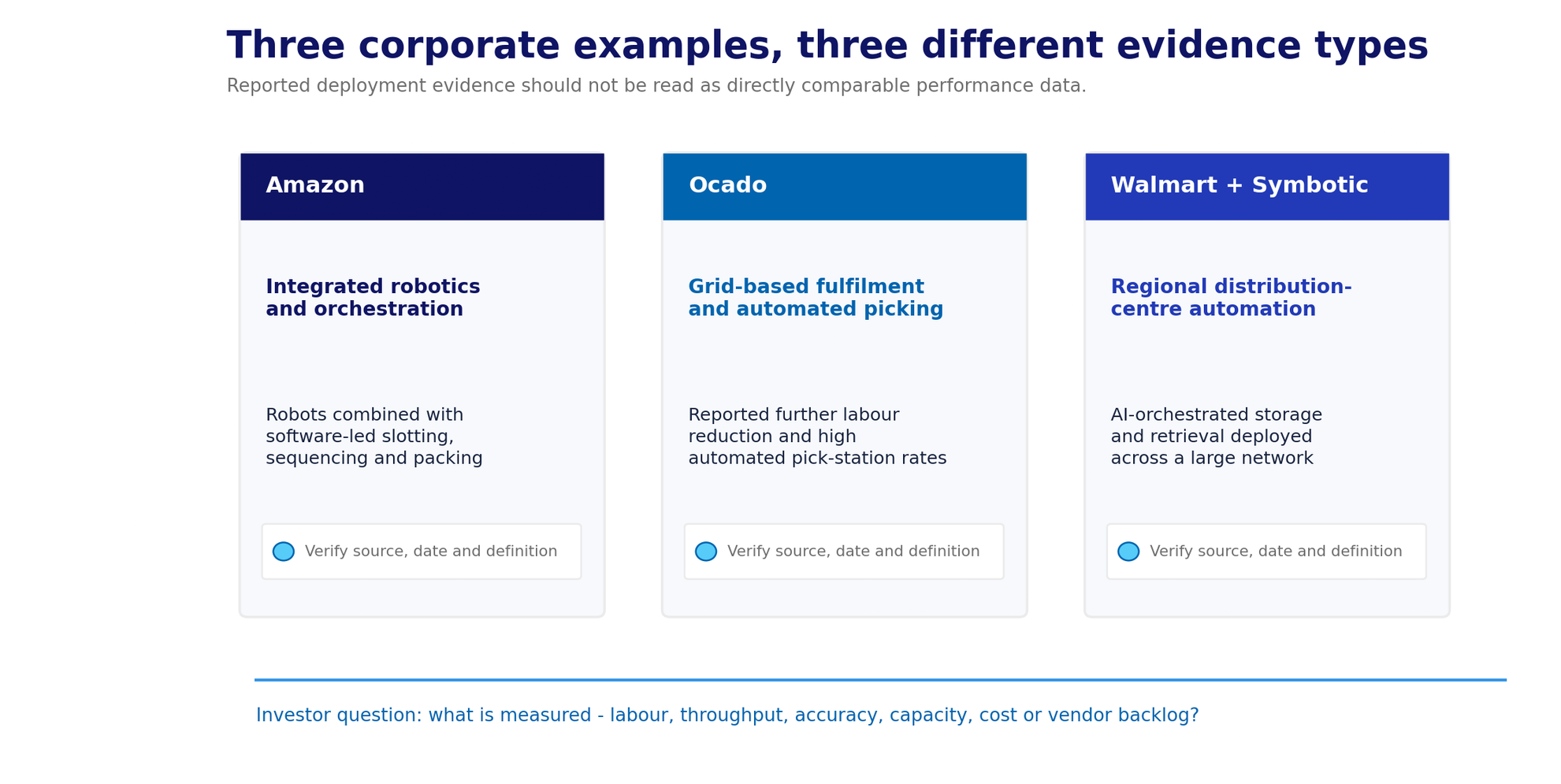
These examples should not be interpreted as directly comparable productivity studies. They measure different outcomes, including labor reduction, items per hour, system deployment, and vendor backlog. A meaningful comparison requires a common definition, time period, facility type, and cost basis.
A changing venture and public-market landscape
Warehousing automation is relatively capital-intensive and increasingly consolidated. Some technique families have produced independent public companies, while others have been absorbed into broader industrial, logistics, or enterprise software platforms.
Symbotic and AutoStore represent public-market examples in automated storage and retrieval. AutoStore’s cube-storage model uses small robots to retrieve bins from a dense grid and serves customers across sectors, including retail, grocery, healthcare, and third-party logistics.
Locus Robotics illustrates the robots-as-a-service model. Its platform coordinates fleets of autonomous mobile robots and the human workers who use them. The source material reports well over six billion cumulative picks by October 2025, funding of $438 million, a reported valuation of $2 billion, and deployment of more than 17,000 robots across more than 360 sites. These figures require confirmation against the latest company disclosures before publication.
The manipulation segment also shows the limits of a strong technology proposition. Covariant developed AI systems for robotic picking and attracted reported acquisition interest from Amazon in 2024. Berkshire Grey, meanwhile, went public through a 2021 SPAC transaction at a reported valuation of $2.7 billion before SoftBank took the company private in 2023 for approximately $375 million.
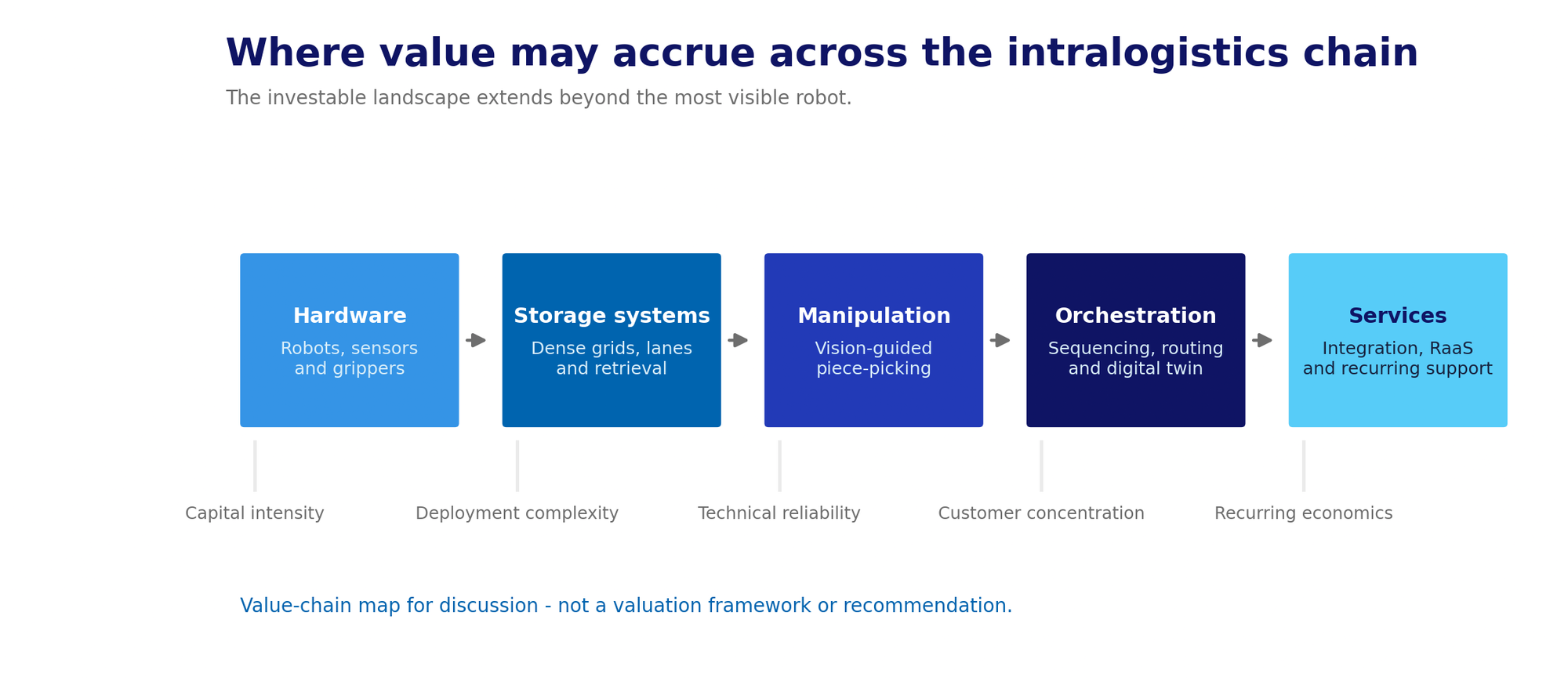
The lesson is not that warehouse robotics lacks potential. It is that technical differentiation, commercial deployment, customer concentration, capital intensity, and exit conditions all shape the investment case. A promising technology roadmap does not, by itself, guarantee durable economic value or investor returns.
What investors should examine
For investors assessing warehouse productivity, the relevant questions extend beyond the number of robots deployed:
- Which part of the pick-pack loop does the system improve?
- Is the reported gain measured as labor reduction, throughput, accuracy, capacity, or total cost per order?
- What facility type, SKU mix, and operating conditions produced the result?
- Does the system require changes to the building, inventory layout, or workforce model?
- Which part of the value is captured by hardware, software, integration, or recurring service revenue?
- How concentrated is the customer base?
- Can the solution operate across customers and use cases, or is it closely tied to one deployment?
- What happens when demand, product mix, or labor availability changes?
These questions help distinguish a genuine productivity mechanism from a broad automation narrative. They also make it easier to compare companies operating at different layers of the value chain.
The broader productivity perspective
Warehousing is a useful example of how productivity improvements can emerge from a system rather than a single invention. Autonomous robots reduce unnecessary movement. Dense storage changes the use of space. Computer vision expands the range of tasks machines can perform. Orchestration software connects these capabilities and coordinates them with human work.
For institutional investors, this systems perspective is important. The opportunity is not simply to identify the most visible robot. It is to understand which companies can translate technology into repeatable operating improvements, defend their position in the value chain and maintain economic relevance as the warehouse becomes more automated.
That is the central question of this installment in Averdas’ twelve-part series: Where can a corporate productivity gain be created, measured, and sustained?
