

Article
A company can grow in two very different ways: by having others sell its inventions—or by doing so itself. Genmab A/S, a Danish antibody company, demonstrates in 2026 how both models can work simultaneously and how differently they impact productivity, control, and risk.
For Averdas, this is an instructive example: it shows how the four productivity factors—Asset, Process, Resource, and Resilience Productivity—can be observed in a real company, rather than merely described in the abstract.
A Company in Transition
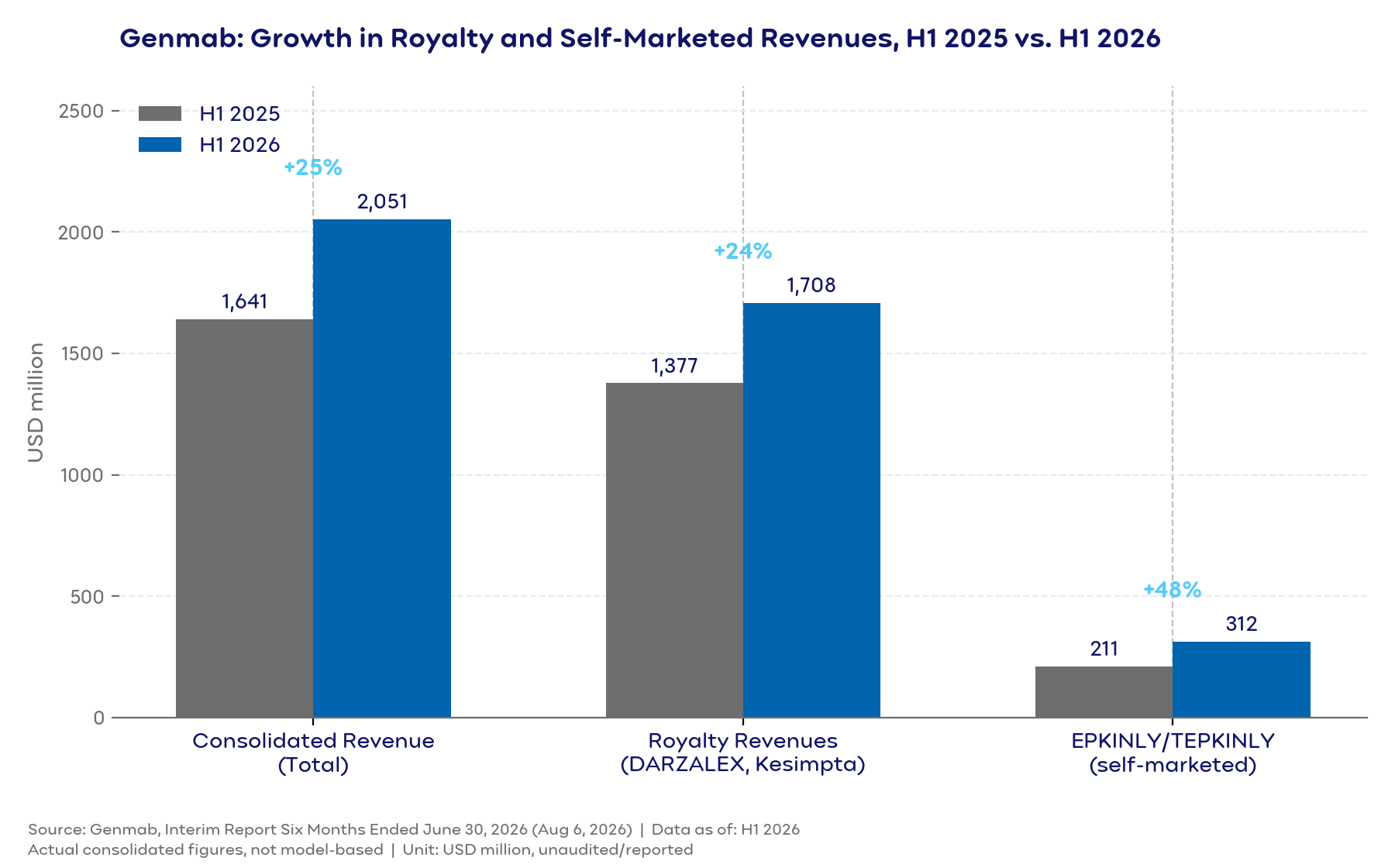
Genmab develops and markets antibody therapeutics. However, a significant portion of its current revenue does not come from its sales but rather from collaborations, milestone payments, and, above all, recurring royalties on products marketed by partner companies worldwide. In the first half of 2026, Genmab’s consolidated revenue rose to $2.051 billion—an increase of 25% compared to the same period last year. The main reasons were higher royalties from DARZALEX and Kesimpta, as well as rising revenue from EPKINLY, a product that Genmab markets itself in collaboration with its partner AbbVie. Genmab subsequently raised its revenue forecast for the full year to between $4.325 billion and $4.525 billion.
Figure 1 illustrates this pattern: both royalty revenue and revenue from the self-marketed EPKINLY/TEPKINLY franchise grew significantly year-on-year—with self-marketing growing noticeably faster (+48%) than the royalty base (+24%).
Asset Productivity: What the Royalty Base Is Worth—and What Limits It
Genmab's most important productive assets are its antibody platforms, clinical drug candidates, intellectual property rights, and licensing and royalty rights to drugs already on the market. The royalties from DARZALEX and Kesimpta clearly demonstrate how research and partnerships can be converted into revenue over long periods of time without Genmab having to build its own sales structures.
However, this model has a downside: part of the value creation and operational execution lies with the partners. Genmab has limited direct influence over the marketing, pricing, and market access of its partners’ products. The expansion of its pipeline—most recently through the acquisition of Merus in December 2025 and the development of its marketing capabilities—may allow Genmab to capture a larger share of the value creation itself in the future. In the first half of 2026, $77 million in acquisition and integration costs were primarily attributable to the integration of Merus; an additional $24 million consisted of amortization of acquired intangible assets, predominantly from the acquired technology platform.
Averdasviews this as a typical asset-productivity issue: Genmab possesses high-quality, scalable intangible assets and a substantial revenue base. Whether this results in additional value creation depends on whether the newly acquired and further developed programs are successfully translated into marketable products.
Process Productivity: From Pipeline toApprovals
In the biopharmaceutical industry, process productivity is primarily reflected in the quality and speed with which a company navigates research, clinical development, regulatory approval processes, and market launch. At the Bank of America Global Healthcare Conference on September 22, 2026, Genmab outlined several clinical milestones expected in the fourth quarter of 2026: Phase 3 data on EPKINLY for first-line treatment of diffuse large B-cell lymphoma, on Rina-S for platinum-resistant ovarian cancer, and initial Phase 3 data on petosemtamab for head and neck tumors.
Positive results could pave the way for regulatory filings and support a broader, more product-driven revenue base. In the first half of 2026, adjusted operating expenses had already risen by 28% to $1.270 billion—driven by pipeline investments in Rina-S and petosemtamab, as well as preparations for future market launches. Adjusted operating profit grew by 18% to $656 million during the same period, a slower rate than revenue growth.
For Averdas, this is an important indicator: higher development expenditures alone do not translate into productivity gains. What matters is whether they translate into robust clinical results and rapid regulatory progress—and whether shared development and commercialization infrastructures for multiple products create additional potential for scale.
Resilience Productivity: Why Partners and In-House Products Go Hand in Hand
“Resilience” describes how a company maintains its performance even under changing conditions—such as when a clinical program fails or regulatory timelines are delayed. At Genmab, this resilience is based on an established and growing revenue base combined with an advanced pipeline.
Royalty revenue of $1.708 billion in the first half of 2026 came primarily from DARZALEX and Kesimpta, which are marketed globally by Johnson & Johnson and Novartis, respectively. Added to this are growing revenues from Genmab’s own product, EPKINLY. These products, which are already on the market, form a foundation while Genmab continues to develop its pipeline—the partnerships delegate parts of the operational execution to established partners, while Genmab simultaneously builds its own commercial capabilities, for example, through the appointment of a general manager for Italy and Spain in September 2026.
The combination of marketed products, royalties, partnerships, and several advanced pipeline programs gives Genmab the flexibility to continue financing development and to cushion the impact of individual setbacks. With each additional proprietary product, the revenue base expands beyond the established partner products—a pattern that Averdas classifies as structurally relevant within its Resilience Productivity analysis.
What This Means for the Averdas Productivity Perspective
Genmab exemplifies why Averdas measures productivity not by a single metric, but by various interrelated factors. A strong royalty base (asset productivity) alone says little about whether a company efficiently converts its pipeline into approvals (process productivity). And a growing pipeline alone does not protect against setbacks if it is not cushioned by a robust, diversified revenue base (resilience productivity).
Averdas examines such relationships quantitatively and using models as part of its proprietary productivity approach. This blog article provides a technical analysis based on published company data; it does not constitute a guarantee of future developments or an investment recommendation.
Conclusion and Outlook
Genmab combines established, royalty-based cash flows with an advanced oncology pipeline while simultaneously expanding its own commercial capabilities. Asset productivity is reflected in the profitability of the antibody platforms, process productivity in the transition of late-stage programs to approvals and market launches, and resilience productivity in the growing and increasingly diversified revenue base.
The next test of value lies in converting pipeline investments into clinically compelling results, approvals, and economically viable product launches. For the coming quarters, the expected clinical data milestones in the fourth quarter of 2026 and the further development of product revenues are key areas to monitor. Positive trial results could further broaden Genmab’s revenue base—however, at this point, they are an expected event, not a realized one.