
Prof. Dr. Leo Brecht


Member of the Board, Partner


Prof. Dr. Leo Brecht
Member of the Board, Partner
Prof. Dr. Leo Brecht is a mathematician and economist with a PhD in mathematical statistics and a professorship in innovation and technology management at the University of Liechtenstein. With over 20 years of experience in management consulting and applied research, and more than 10 years in investment management, he is a leading expert in the fields of innovation, technology and product management. Leo Brecht has supported more than 100 projects for SMEs and multinational companies in various industries, from strategic consulting to technology assessments. He is also the founder of ALPORA, where he and his team have developed innovative investment products that have led to over €700 million in assets under management. Over the last ten years, he has given more than 1,000 investor presentations. He was a partner at Andersen and Arthur D. Little, the author of several books and a conference speaker. As an active investor and serial entrepreneur, he is particularly involved in the FINTECH, SUSTTECH and EDUTECH sectors. In his free time, Leo Brecht is a passionate regatta sailor and skier and enjoys spending time with his family.
A Problem with More Solutions Than Can Be Tested by Hand
Imagine a delivery driver who has to make 150 stops in a single day. The number of possible sequences in which these stops can be arranged grows combinatorially with each additional stop—and quickly exceeds what even the most experienced dispatcher could evaluate manually. UPS alone calculates more than 200,000 alternative route variations for every driver, every day.
For a long time, this problem was solved using driver experience and static route tables that were updated only seasonally, at most. The issue with such a solution: the cost of an inefficient route adds up daily and across tens of thousands of vehicles. This is precisely why logistics costs are typically spread across several independent, mutually reinforcing factors, rather than being concentrated on a single bottleneck—as is the case, for example, with picking in a warehouse.
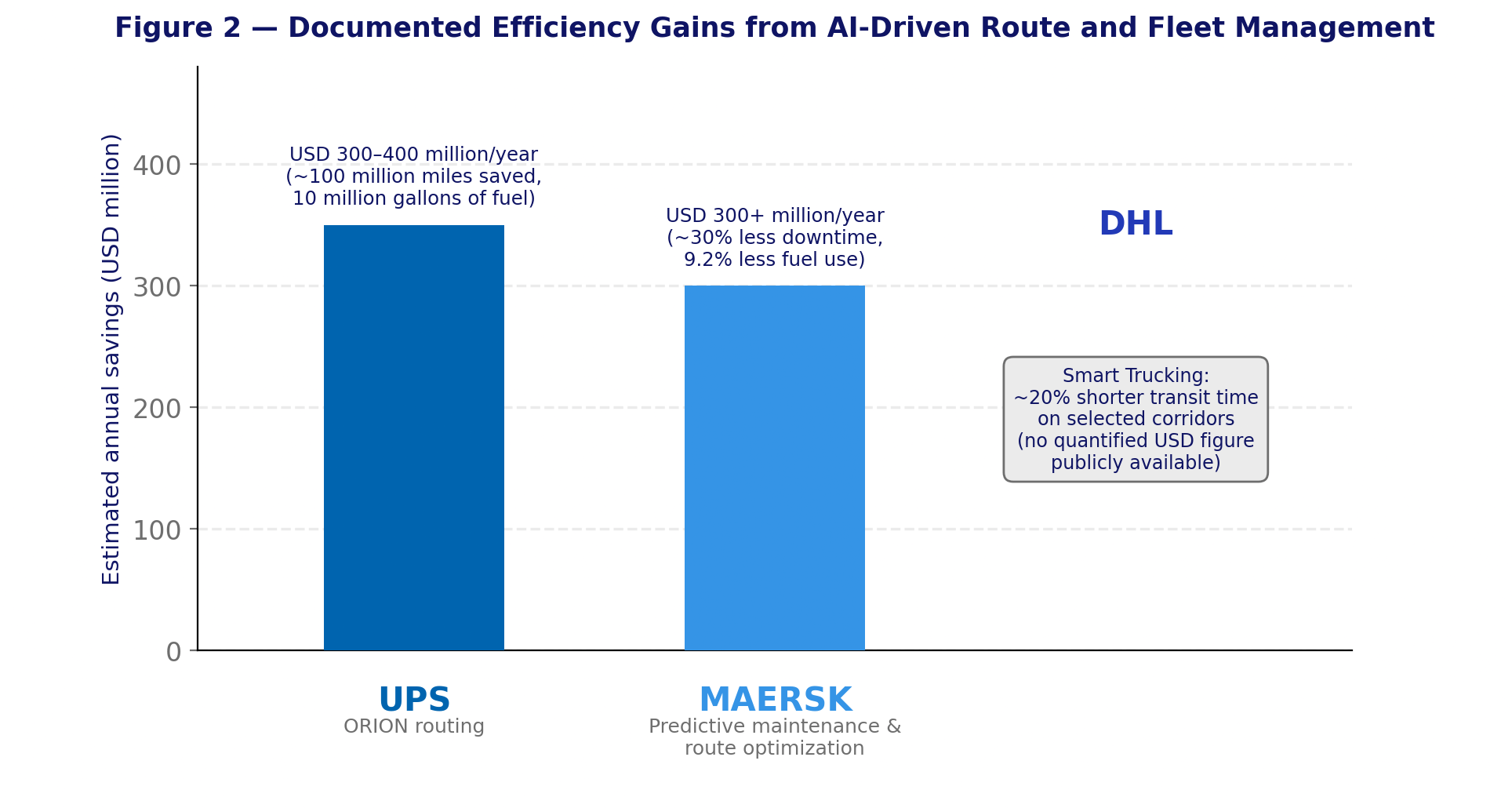
This distributed structure also explains the scale of the documented gains. UPS’s ORION routing system—one of the most extensively studied applications of operations research in corporate history—has saved the company approximately 100 million driven miles and 10 million gallons of fuel annually since its full rollout, an estimated annual value of USD 300 to 400 million. At Maersk, AI-powered predictive maintenance and route optimization across a fleet of more than 700 container ships are reported to have reduced vessel downtime by about 30 percent and generated more than USD 300 million in annual savings. This was accompanied by a 9.2 percent reduction in fuel consumption from AI-driven route optimization alone. DHL reports a roughly 20 percent reduction in transit time on particularly disruption-prone corridors thanks to AI-powered smart-trucking tools.
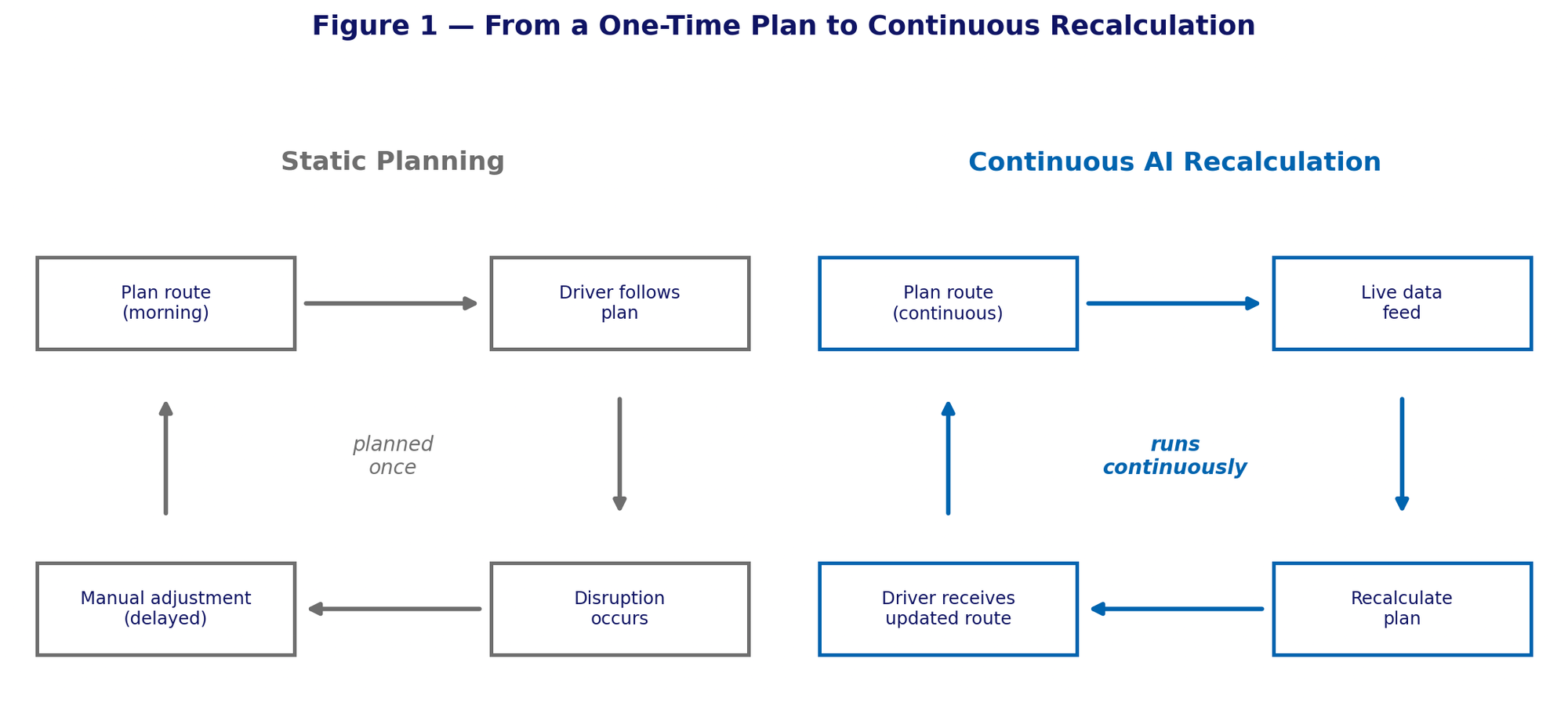
As in every installment of this series, no single technology accomplishes this on its own. Route optimization and dispatch engines replace one-time morning planning with continuous recalculation. Supply-chain visibility platforms give shippers a real-time, predictive view of where a shipment actually is—rather than where it is supposed to be according to the schedule. Fleet telematics and AI-powered driver-safety systems turn every vehicle into a live data source. And at the technological frontier, autonomous vehicles—both sidewalk robots and highway-capable driving systems—are beginning to remove the human driver from parts of the last mile entirely.
Why This Domain Is a Productivity Lever
Logistics costs are spread across route planning, carrier selection, documentation, and last-mile execution. As a result, efficiency gains accumulate across several independent levers, rather than being concentrated on a single bottleneck, as is the case with picking in a warehouse, for example. McKinsey estimates that artificial intelligence can reduce total logistics costs by about 15 percent through process optimization alone—a more moderate figure compared to other domains in this series, but one that applies to a significantly larger and more dispersed cost base. The associated, fastest-growing sub-segment, “AI in logistics,” was valued at nearly USD 18 billion in 2024 and continues to grow at an annual rate of more than 40 percent.
The routing problem itself is a textbook example of AI-driven acceleration: the number of possible sequences for a multi-stop delivery route grows combinatorially with each additional stop and far exceeds what a dispatcher can evaluate by hand—regardless of experience. A route that is planned once and followed rigidly systematically leaves efficiency on the table whenever real-world conditions—such as traffic, delayed pickups, or canceled orders—diverge from the plan. A system that continuously resolves the routing difficulty in the background can close this gap at a speed and scale that manual replanning cannot match.
The Technology Toolkit in Plain Terms
Route optimization receives the most public attention because it produces the most quotable statistics. However, the actual productivity gain in this domain stems from a broader toolkit spanning planning, visibility, safety, and, increasingly, the vehicle itself:
- Solving the routing difficulty continuously (AI route optimization and dispatch): operations-research and machine-learning engines that evaluate hundreds of thousands of possible route sequences and re-solve the plan throughout the day, rather than fixing the sequence once each morning. This is the highest-value layer in this domain—and also the one that large logistics carriers have most consistently built in-house rather than bought.
- Knowing where everything actually is (supply-chain visibility and control towers): platforms that combine live GPS, telematics, and carrier data to give shippers a continuously updated, predictive view of shipment location and estimated arrival time—instead of the traditional model of calling a carrier to ask where a truck is.
- Turning every vehicle into a sensor (fleet telematics and AI driver-safety): connected hardware and AI models that monitor vehicle location, driver behavior, and equipment condition in real time—both to improve routing decisions and to catch unsafe driving patterns early.
- Taking the human off the sidewalk (autonomous delivery robots): small, low-speed autonomous robots that complete short last-mile deliveries—food, groceries, and parcels—without a human driver, suited to dense urban environments or campus settings where a full-size vehicle would be inefficient.
- Taking the human off the road (autonomous highway driving technology): self-driving systems that operate delivery and passenger vehicles on public roads without a human driver—either as a vertically integrated delivery service or, increasingly, as licensed technology sold to vehicle manufacturers and mobility platforms.
What This Is Worth, in Numbers: Three Corporations Compared
The underlying mechanism is the same throughout this series: replacing a route that is planned once and followed rigidly with one that is continuously recalculated against live conditions closes the gap between plan and reality throughout the day. Reported results vary by company and by what is being measured—miles saved, vessel downtime, or transit time—but each of the three examples below is grounded in a named, verifiable deployment at one of the world’s largest logistics carriers.
UPS—ORION routing system. The “On-Road Integrated Optimization and Navigation” system calculates the most fuel-efficient sequence of stops for each driver from among more than 200,000 possible route combinations, updating it continuously as conditions change. Since its full rollout, ORION has saved approximately 100 million driven miles and 10 million gallons of fuel every year—an estimated USD 300 to 400 million in annual cost savings—while cutting roughly 100,000 metric tons of CO₂ emissions annually. The system, whose development is estimated to have cost USD 250 million, had already saved more than USD 320 million by the end of 2015.
Maersk—AI-driven predictive maintenance and route optimization. Maersk uses AI models that combine sensor data from its vessels with weather and port congestion information to optimize routing, fuel consumption, and maintenance scheduling across a fleet of more than 700 container ships. Vessel downtime is reported to have been cut by about 30 percent through predictive maintenance, said to have generated more than USD 300 million in annual savings, alongside a 9.2 percent reduction in fuel consumption from AI-driven route optimization alone. Maersk completed the full rollout of its proprietary AI-powered analytics platform across its entire container vessel fleet in January 2026.
DHL — AI-powered smart trucking. DHL uses AI-powered smart-trucking tools that combine real-time traffic and weather data to help drivers avoid delays on particularly disruption-prone corridors—including a widely cited initiative in India. The company reports a roughly 20 percent reduction in transit time from this initiative, alongside savings on fuel and maintenance expenses from more consistent driving behavior.
Important note: These figures come from corporate and third-party sources, in particular BSR and INFORMS case studies on UPS ORION, as well as Maersk’s investor and sustainability communications and published DHL materials. The Maersk figures on downtime and savings in particular are widely reported but not confirmed in a single primary source and should be treated as directionally indicative.
How the Venture Landscape Around the Core Problem Is Evolving
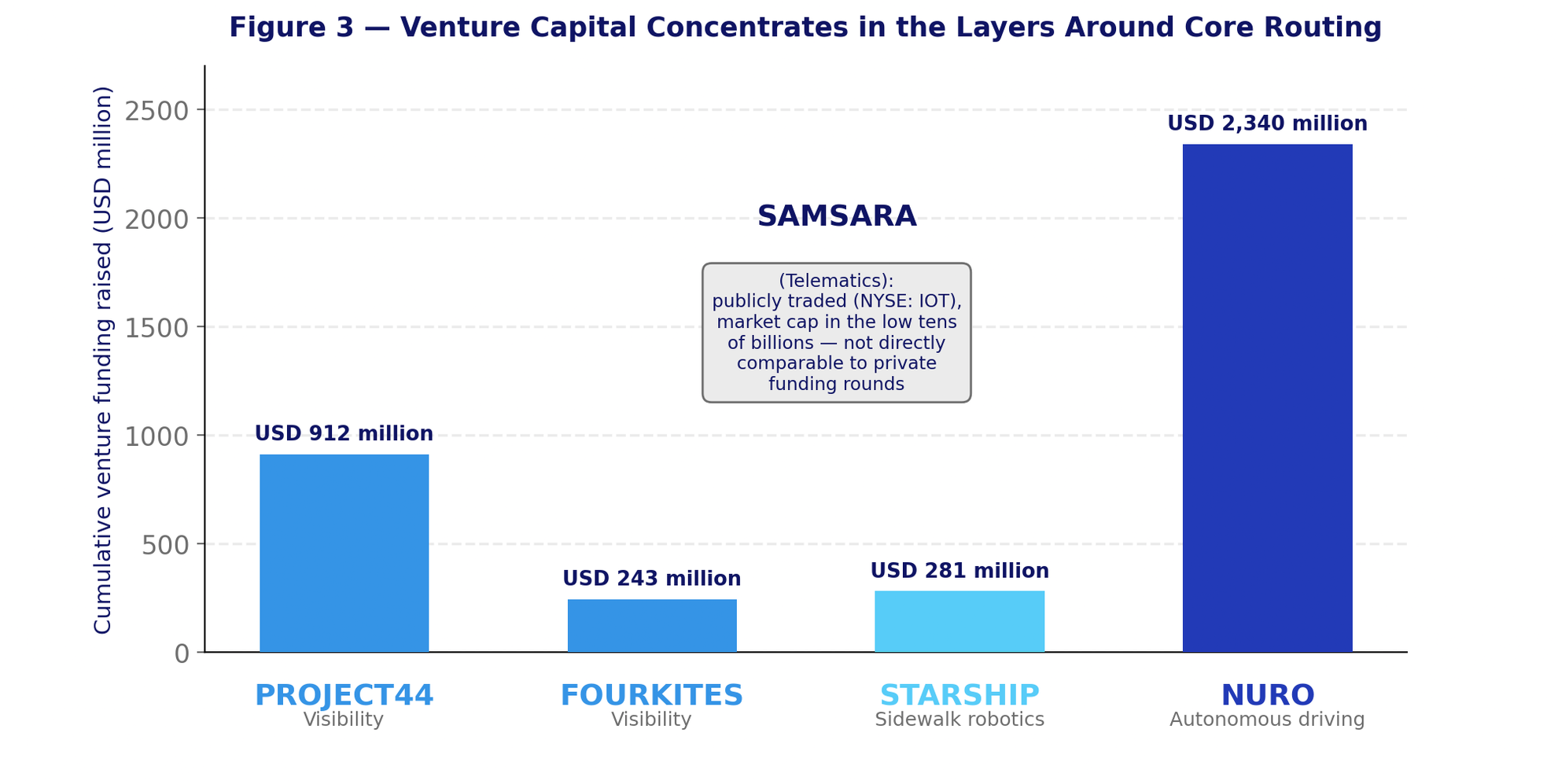
For capital allocators, the picture is one of a market structure in which the core routing capability itself remains largely proprietary to the world’s largest logistics carriers: UPS, Maersk, and DHL have each built their most valuable routing systems in-house rather than buying them. Venture capital has instead concentrated on the layers around this core—visibility, telematics, and autonomous vehicles.
In supply-chain visibility, project44 and FourKites have established themselves as two well-capitalized, closely matched competitors, both processing more than a billion shipments a year for overlapping enterprise customer bases—a genuine head-to-head market rather than one with a clear leader. Project44 has raised approximately USD 912 million and is valued at USD 2.7 billion; FourKites has raised USD 243 million and reached a valuation of USD 1 billion.
Autonomous vehicles are the most capital-intensive and fastest-evolving part of the domain. Nuro has raised USD 2.34 billion and shifted its focus from operating its delivery robots to licensing its self-driving technology to Uber and Lucid for robotaxi applications. Starship Technologies has taken the opposite path, focusing on short-distance, low-speed sidewalk delivery—with more than 9 million completed deliveries—rather than chasing the harder problem of full highway autonomy, and reports positive gross margins, a rare profitability claim among autonomous-delivery ventures.
Samsara, a publicly traded company (NYSE: IOT) in fleet telematics, has a market capitalization in the low tens of billions, with annual recurring revenue above USD 1.3 billion and sustained double-digit growth since its 2021 IPO.
Implications for Institutional Investors
For companies with extensive logistics or fleet operations, this domain shows a typical pattern of structural productivity gains: the largest documented effects do not come from a single technology but from the systematic interplay of several complementary systems over multiple years. This is consistent with the underlying logic of the Averdas productivity approach: structural efficiency potential often cannot be read off a single metric, but shows up in the interaction of process, resource, and resilience factors over time.
For the concrete operationalization of these relationships within the four Averdas productivity factors—Asset Productivity, Process Productivity, Resource Productivity, and Resilience Productivity—we refer readers to the corresponding methodology documentation as well as the other articles in this series.
