
Prof. Dr. Leo Brecht


Member of the Board, Partner


Prof. Dr. Leo Brecht
Member of the Board, Partner
Prof. Dr. Leo Brecht is a mathematician and economist with a PhD in mathematical statistics and a professorship in innovation and technology management at the University of Liechtenstein. With over 20 years of experience in management consulting and applied research, and more than 10 years in investment management, he is a leading expert in the fields of innovation, technology and product management. Leo Brecht has supported more than 100 projects for SMEs and multinational companies in various industries, from strategic consulting to technology assessments. He is also the founder of ALPORA, where he and his team have developed innovative investment products that have led to over €700 million in assets under management. Over the last ten years, he has given more than 1,000 investor presentations. He was a partner at Andersen and Arthur D. Little, the author of several books and a conference speaker. As an active investor and serial entrepreneur, he is particularly involved in the FINTECH, SUSTTECH and EDUTECH sectors. In his free time, Leo Brecht is a passionate regatta sailor and skier and enjoys spending time with his family.
Process Productivity in Practice: The Case of Procurement
This post is Part 6 of our twelve-part series on business areas with demonstrable productivity gains. You can find the entire series here.
Not every business unit is equally well-suited for making productivity visible. Some processes are too unstructured, occur too infrequently, or are too difficult to quantify. Corporate procurement—that is, the purchasing of materials, services, and supplier contracts—is one of the few areas where the opposite is true: every order, every invoice, and every supply contract is already structured, time-stamped, and directly linked to a monetary amount. This combination of high transaction volume, clearly defined data, and a direct link to the company's bottom line makes procurement one of the most clearly documented use cases for AI-driven process automation.
Why This Particular Business Area
The economic logic is simple but rarely as clearly fulfilled as it is here: a model needs a learning signal that it can derive from existing data—and in procurement, this data is already available in numerical form and chronologically organized before an automation system even intervenes. Every efficiency improvement can be measured directly against a known expenditure baseline without the need for a separate survey. This also explains why, compared to other industries, procurement AI often has the shortest payback period of all business applications—typically six to eighteen months, according to the cited McKinsey analysis.
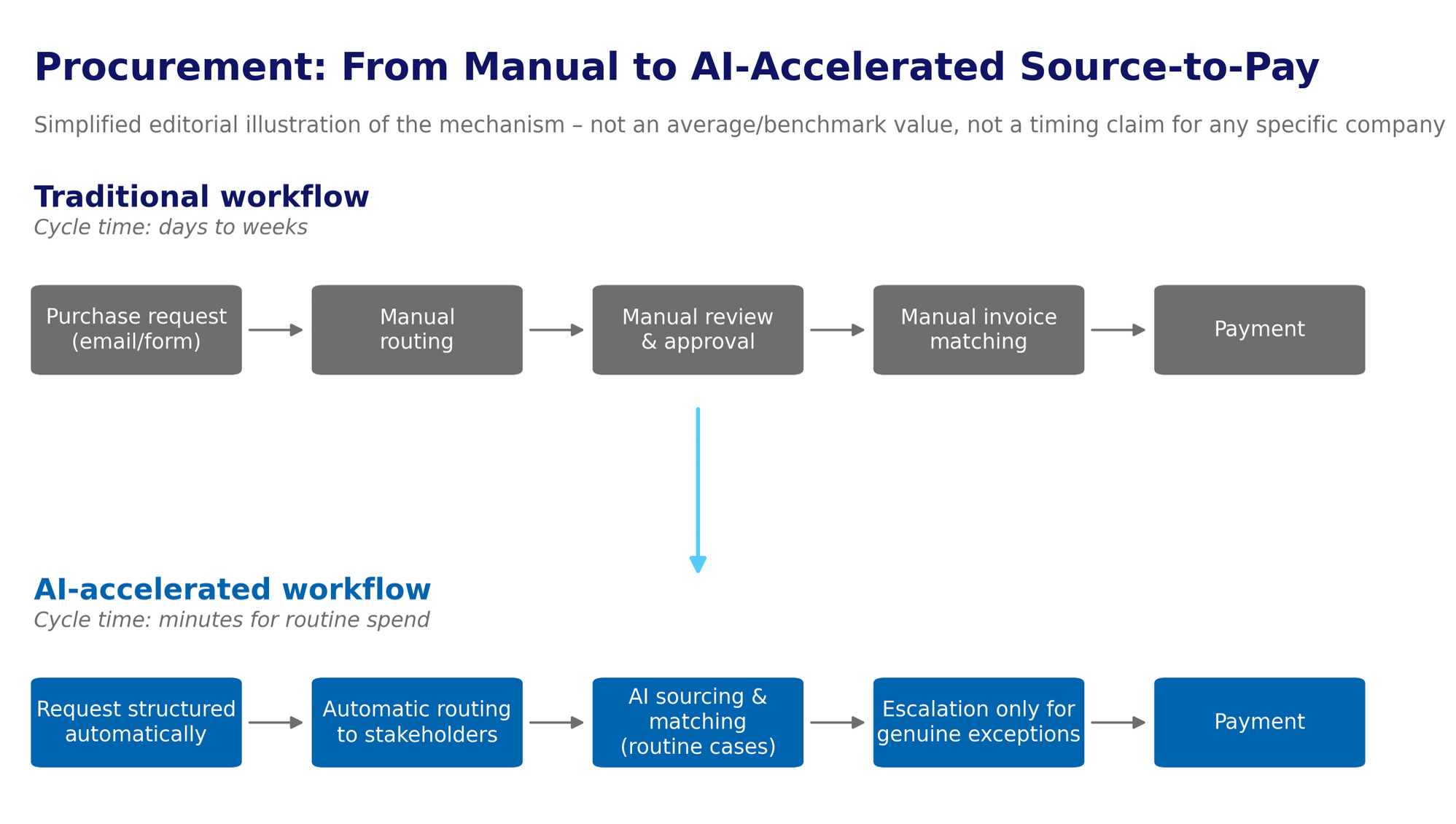
For companies, this means that routine decisions—such as reordering a standard part or forwarding a low-value purchase request—follow patterns that are predictable enough for a system to handle them without human review. This frees up capacity for the tasks where human judgment actually makes a difference: negotiations and supplier relationships.
A Toolkit Rather Than a Single Technology
As in many areas we are examining in this series, productivity gains do not come from a single technology but from the interplay of several layers:
- Negotiation agents: systems that independently conduct bidding processes, evaluate suppliers based on more than just price, and—in mature applications—can routinely conclude supplier contracts within a defined framework of rules.
- Spend analysis: models that automatically classify procurement data and uncover so-called "maverick spend"—expenditures outside existing contracts—which manual category reviews would struggle to detect due to the volume of transactions.
- Supplier risk monitoring: systems that continuously analyze financial data, geopolitical developments, and news signals rather than waiting for periodic manual reviews, as has been the case in the past.
- Invoice automation: document AI that automatically matches invoices with purchase orders and delivery notes—according to the source document, this now accounts for 80 to 90 percent of invoice volume at large companies without manual intervention.
- Intake-to-procure orchestration: platforms that immediately structure an informal procurement request and automatically forward it to the appropriate departments in finance, legal, security, and procurement.
Three Companies, Three Different Examples
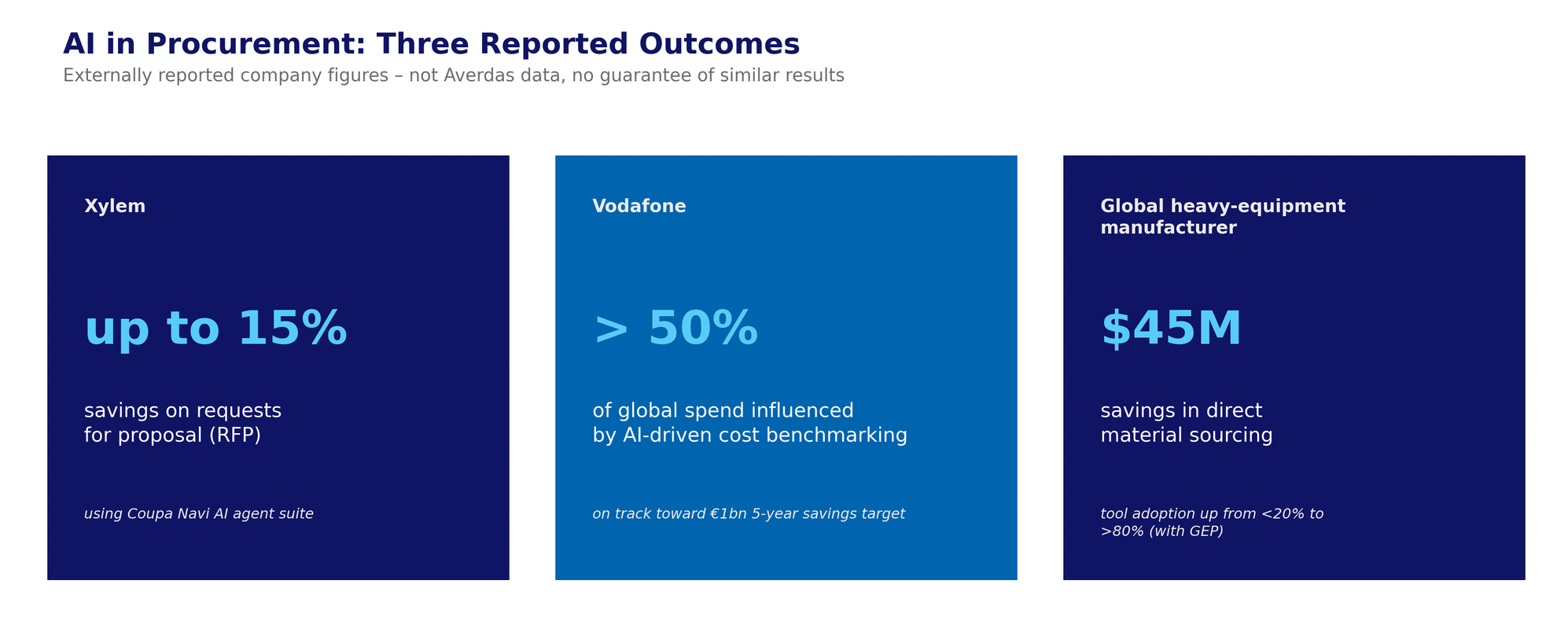
The documented results are concrete and varied:
- Xylem, a water technology company, uses CoupaNavi’s AI agent suite in procurement and reports savings of up to 15 percent on tenders.
- Vodafone has established an AI-powered procurement cost team that now influences more than 50 percent of global procurement spending and has already achieved several hundred million euros in savings toward a five-year goal of 1 billion euros.
- A global manufacturer of construction equipment, which works with the provider GEP, increased the utilization of its procurement system from less than 20 percent to over 80 percent, thereby achieving $45 million in savings on direct materials procurement.
Why This Is of Interest to Institutional Investors
Procurement is an example of how Process Productivity—one of the four factors in the Averdas analytical framework—can be observed in concrete terms within a business unit: the efficiency of operational workflows and processes can be gauged here particularly directly through metrics such as the savings rate, degree of automation, and lead time. This makes procurement an instructive, yet deliberately narrow, case study—it describes a mechanism observed in individual companies, not a guarantee of future results or a blanket measure of corporate quality.
The investment landscape surrounding these technologies is also changing: major platforms such as Coupa, SAP Ariba, and Ivalua have already integrated a significant portion of risk and invoice automation into their suites, while independent, venture-funded companies are focusing on intake-to-procure orchestration and autonomous negotiation technology—two fields that, according to the source document, remain highly competitive and do not yet have a clear market leader.
Context and Limitations
The effects described here are derived from publicly reported case studies of individual companies and from analyst reports (including McKinsey, Boston Consulting Group, and Gartner). They are not intended to serve as a universal benchmark for every company or industry, and they do not constitute a statement regarding future Averdas product results, index performance, or fund performance.
